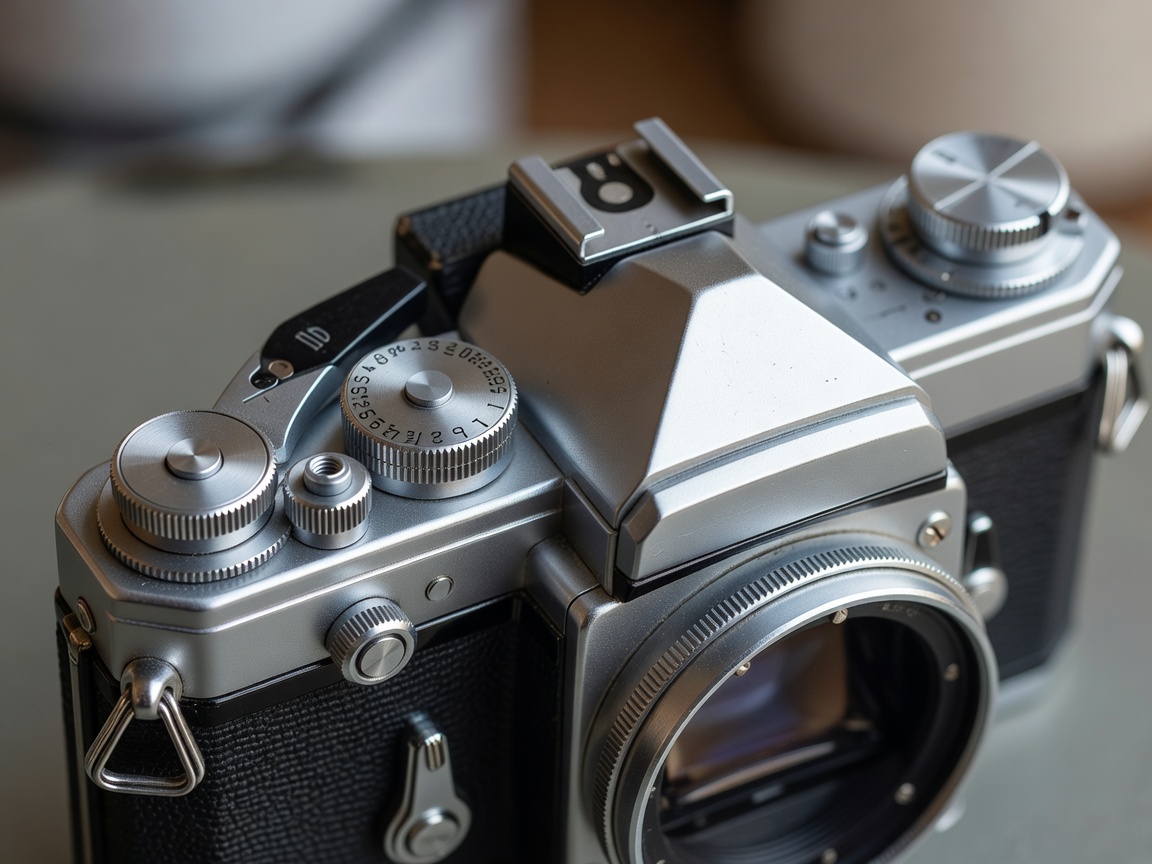
In an age where image capture is instantaneous, infinite, and inherently disposable, the return to analog film photography represents a desire for friction. Vintage cameras demand an understanding of the relationship between aperture, shutter speed, and film sensitivity. They enforce a hard physical limit—typically 36 exposures—that forces the photographer to slow down and consider composition before actuating the shutter.
Fully Mechanical Marvels
The pinnacle of vintage camera design can be found in fully mechanical bodies produced in the 1970s and early 80s. Constructed from brass and steel, these devices require no batteries to operate (save for sometimes powering a simple light meter). The shutter mechanisms are controlled entirely by a complex series of gears, springs, and levers governed by clockwork escapements.
When you advance the film lever on a mechanical Single Lens Reflex (SLR) camera, you are simultaneously pulling the next unexposed frame of film from the canister, tensioning the main shutter spring, and resetting the mirror mechanism. The resulting tactile resistance and mechanical sound are completely divorced from the synthetic click of a modern smartphone camera.
Camera Archetypes
- The SLR (Single Lens Reflex): The most common enthusiast camera format. Light enters the lens, bounces off an angled mirror into a pentaprism, and through the viewfinder. You see exactly what the lens sees. When the shutter fires, the mirror slaps up out of the way, the shutter curtains travel across the film plane, and the mirror drops back down.
- The Rangefinder: Favored by street photographers for their quiet operation and compact size. Instead of looking through the taking lens, the photographer looks through a separate viewfinder window. Focusing is achieved by turning the lens ring until a secondary, superimposed ghost image aligns perfectly with the main subject in the viewfinder. Because there is no moving mirror, rangefinders can be shot at slower shutter speeds without inducing camera shake.
- Medium Format (TLR / Modular SLRs): Using much larger 120 format film, these cameras produce negatives with incredible resolution and tonal depth. Twin Lens Reflex (TLR) cameras feature two stacked lenses—one for viewing and one for taking the photo—while modular medium format SLRs allow the photographer to swap viewfinders, film backs, and lenses on a central cubic body.
The Chemistry of Film
The aesthetic appeal of analog photography is intrinsically linked to the physical properties of the film stock. Unlike digital sensors which utilize a rigid grid of square pixels, film grain consists of silver halide crystals distributed randomly within gelatin layers. This random distribution yields a more organic texture, particularly in the transition from focus to out-of-focus areas (bokeh).
Different film stocks offer drastically different color palettes. Slide film (positive film) is notorious for its vivid color saturation and unforgiving exposure latitude, meaning any error in calculating light will result in a ruined image. Color negative film is much more forgiving, often capable of capturing detail even when heavily overexposed. Black and white film relies heavily on physical color filters placed over the lens to control contrast, turning skies dark with a red filter or lightening foliage with a green one.
Maintenance and Sourcing
Acquiring vintage camera gear requires vigilance. The main enemies of old lenses are fungus (which etches into the glass coatings) and oil migration onto the aperture blades (which causes them to stick). For camera bodies, light seals—strips of foam meant to keep the dark chamber light-tight—inevitably degrade into a sticky residue and must be replaced. Fortunately, due to their purely mechanical nature, qualified technicians can often disassemble, clean, lubricate, and reassemble these cameras, bringing them back to factory specifications for another fifty years of use.