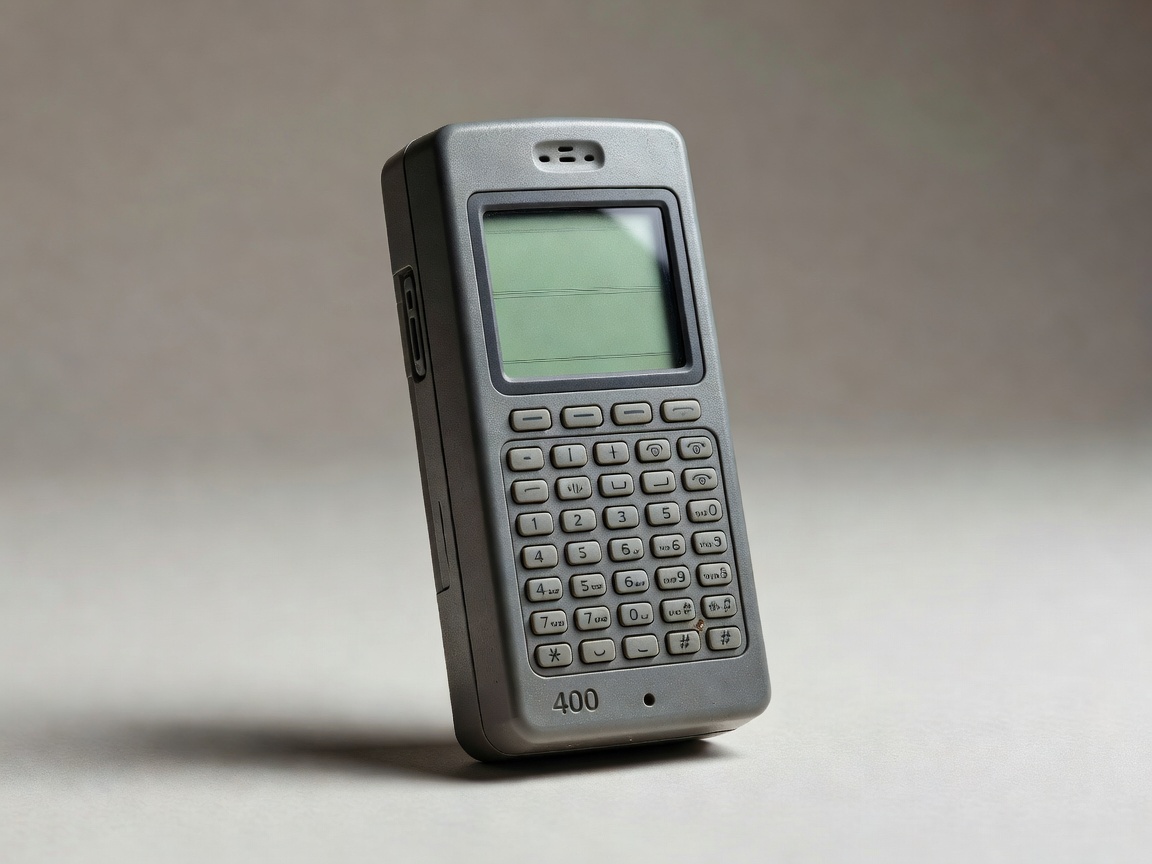
Before smartphones subsumed the roles of cameras, maps, media players, and personal computers, a mobile phone had one primary function: making voice calls untethered from a landline. The hardware produced during the first two decades of cellular technology reflects an era of wild experimentation in form factor, battery technology, and user interface design.
The 1G Era: The Heavyweights
The earliest commercial cellular networks (1G) were purely analog. They transmitted voice signals via radio waves without encryption, making calls susceptible to interception by anyone with a tuned radio scanner. The handsets of this era, famously pioneered by models like the Motorola DynaTAC, were massive.
Earning the moniker "brick phones," these devices were over a foot long, weighed roughly two pounds, and offered merely 30 minutes of talk time after a ten-hour charge. The bulk was necessitated by the large analog radio transceivers and the heavy Nickel-Cadmium (NiCd) batteries required to power them. Because of their exorbitant cost and limited battery life, these early devices were largely status symbols for business executives.
The 2G Revolution and Miniaturization
The transition to 2G digital networks (such as GSM) revolutionized the industry. Digital signals could be compressed, massively increasing network capacity, and encrypted for privacy. More importantly, digital transmission required less power, allowing handset manufacturers to dramatically shrink the size of the devices and utilize newer Nickel-Metal Hydride (NiMH) and eventual Lithium-ion batteries.
This era birthed the distinct form factors we now view with nostalgia:
- The Candybar: The standard, rugged rectangle dominated by a numeric keypad and a small monochrome LCD screen. Characterized by incredible durability and battery life measured in weeks rather than hours.
- The Flip Phone (Clamshell): By hinging the device in the middle, manufacturers could offer a large keypad and screen while maintaining a small footprint in the pocket. Closing the phone provided a satisfying physical end to a call and protected the screen.
- The Slider: An evolution that kept the screen exposed for quick reading of incoming SMS messages, while sliding up or down to reveal a tactile keypad for composing replies.
The Interface: Tactility and T9
Because screens were small and often not touch-sensitive, navigating the interface required physical buttons. UI design was strictly hierarchical, relying on dedicated "soft keys" positioned under the display to map functions dynamically based on the current menu screen.
Texting on a numeric keypad spurred the creation of T9 (Text on 9 keys) predictive text. Instead of multi-tapping a key to reach a specific letter (pressing '7' four times to get 'S'), users simply pressed each number key once for a given letter, and a software dictionary predicted the intended word. Mastering T9 allowed users to type out messages rapidly, often without even looking at the device—a tactile skill lost to the era of flat glass screens.
Obsolescence by Network
Unlike vintage audio equipment or film cameras, which can function indefinitely if mechanically maintained, early mobile phones face a hard limit: network support. As telecommunications companies shut down older 1G and 2G networks to allocate radio frequencies to 4G and 5G data services, these vintage handsets lose their ability to connect.
While some hobbyists utilize software-defined radios (SDRs) to create localized, low-power base stations to keep these devices artificially "alive" for demonstration purposes, they are no longer practical communication tools. They exist now primarily as industrial design artifacts, reminding us of a time when phone batteries lasted a week and physical keyboards reigned supreme.